
Making Space Beyond the Object | Kūkan Geijutsu (空間芸術)
Yoko Kajio, Space, Sound and the Place of Contemporary Art

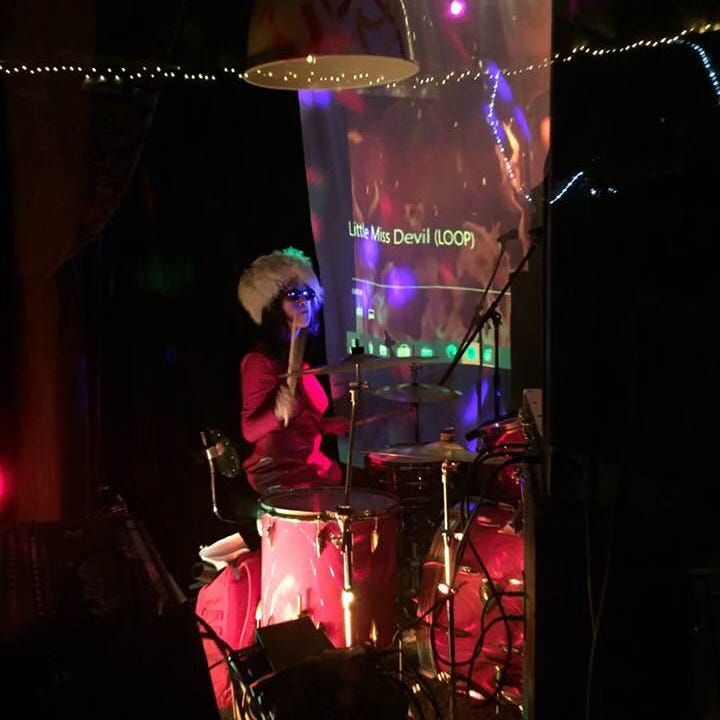
Where does the artwork begin?
When we sat down to speak with Yoko Kajio, I expected that we would begin in familiar territory. I expected we would start with biography, exhibitions, perhaps questions around process and materials, and eventually move into broader discussion around contemporary practice. Instead, like many conversations between artists, we began somewhere far less formal and perhaps much more revealing.
There were discussions about lamps and camera angles and whether the light should sit higher or lower because overhead light has a habit of making everyone feel older than they are. There were questions about sound and echoes and whether headphones would solve the problem or create another one. Tea appeared. People moved in and out of frame. Gizmo settled into his usual supervisory role. Nothing extraordinary was happening, and yet looking back afterwards I found myself wondering whether perhaps the conversation had already begun before any formal questions had been asked.
What stayed with me was not the technical setup but the way Yoko approached it. There was no impulse to force the room into perfection. Instead there was adjustment, observation and responsiveness. The conditions of the room were not separate from the process but seemed to become part of it. At the time this barely registered. Later it began to feel strangely connected to the way she would speak about making work.
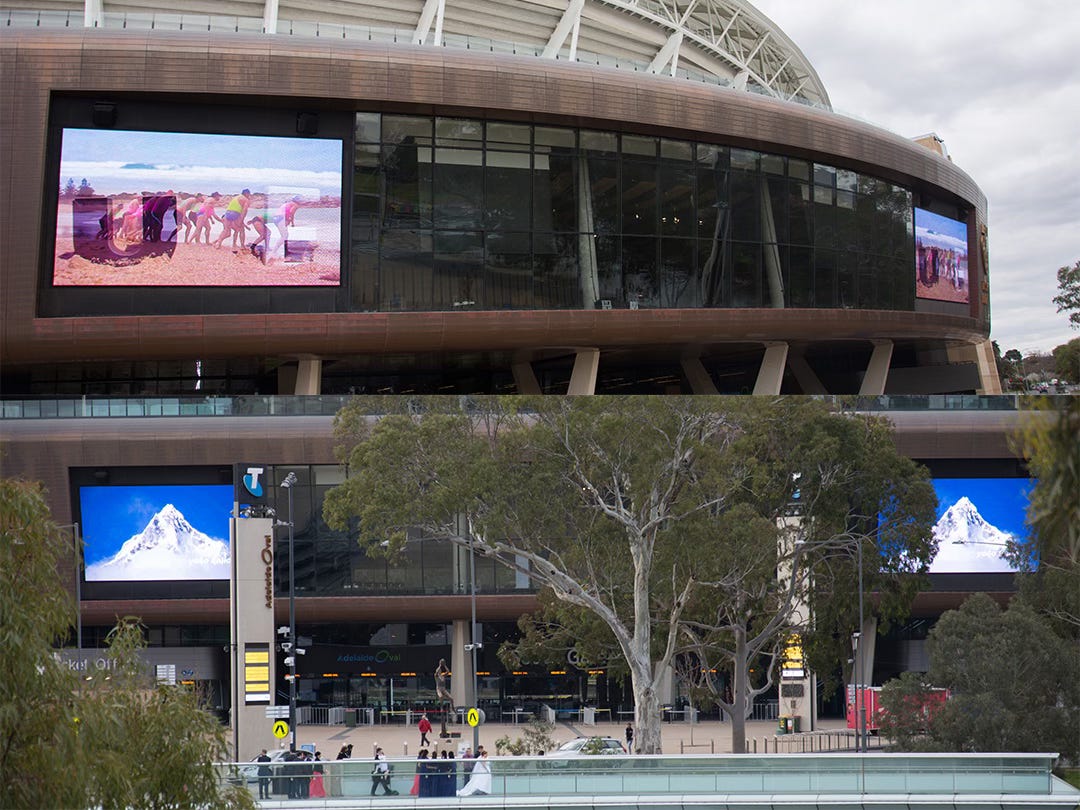
Above: Adelalide Oval, SALA festival, Where sport meets art, U Enter, 2015
Adelaide, Australia / Moving image
CACSA CONTEMPORARY 2010: The New New - Yoko Kajio talks about her artwork shown as part of the Contemporary Art Centre of South Australia’s multi-site visual art project
Yoko Kajio was born in Japan and now lives and works in South Australia. Over several decades she has developed a practice that moves across installation, moving image, photography, performance and sound. Her work sits across artist-led initiatives, independent projects, international collaborations and institutional contexts, and has included long-standing involvement with networks such as Nine Dragon Heads. Yet when asked how she preferred to describe herself she answered simply that she was an artist. Not installation artist. Not sound artist. Not visual artist. Just artist.
Initially that answer felt modest. As the conversation unfolded it became clear that perhaps categories themselves are not especially useful for understanding the way she thinks.
Again and again, whenever discussion moved toward medium, Yoko redirected attention elsewhere. She spoke about space. She spoke about time. She spoke about listening. She spoke about relationships. She spoke about environment. At one point she said something that quietly reframed the entire discussion. She explained that her canvas was space.
This sounds familiar within contemporary art language, until you realise she is not speaking about space as a location where artwork sits. She seems to be describing something much more difficult, perhaps something that does not move easily into English.
Space as relationship rather than container
Kūkan Geijutsu (空間芸術) Pronounced: Koo-kan Gay-joot-soo | “Spatial Art” or “Art that uses space as its medium.”
Several times during our conversation, Yoko paused and reflected on the difficulty of translation. She referred to Japanese concepts connected to time and space existing together and spoke about ideas that seemed to contain multiple meanings simultaneously. There were references to invisible threads between people and to ways of understanding emptiness that felt quite different to common Western assumptions. She spoke about silence and intervals and at one point reflected that human beings are born and given time and space.
What interested me was not simply the philosophical content of these reflections but what they seemed to reveal about the structure of her practice.
Within much Western contemporary thinking, space is often treated as neutral. It is the gallery. The room. The site. The container waiting for the artwork to arrive. Even installation practices that move beyond the wall often still assume space is something to occupy or transform.
Listening to Yoko, I began to suspect that she was describing something closer to a relational understanding of space. Not empty space waiting to receive meaning but active space that already contains relationships, histories, memories, rhythms and possibilities before the artist enters. The artwork does not necessarily impose order onto the room but makes visible things that already exist inside it.
This perhaps explains why she resisted prescribing audience responses. Several times during our conversation she suggested that once the work enters the world the audience brings their own experience and meaning. There was no desire to tightly control interpretation. The work creates conditions for encounter rather than instructions for understanding.
I found myself thinking about how difficult this position can become inside contemporary cultural environments that increasingly ask artists to explain outcomes in advance. Explain impact. Explain audience response. Explain measurable value.
What happens to practices built around uncertainty and encounter?
TAGSoundAcademy Live August 2024 at ARTHUR-Art Bar / Innovation District
Sound, listening and the refusal to become decorative
One of the things that surprised me most during our conversation was the degree to which sound sits at the centre of Yoko’s practice.
Before visual art came music.
She spoke about being young in Japan and saving lunch money so she could attend performances by international musicians. Later she became involved in experimental sound environments and continues collaborative sound practice and recording from a studio environment in South Australia. This detail felt important because it fundamentally changed the way I began thinking about her installations.
What if these works are not primarily visual? What if they are composed?
Once I started thinking about her work through sound rather than image, many things began to make sense. The attention to intervals. The comfort with silence. The resistance to fixed interpretation. The responsiveness to environment. Her installations began to feel less like visual arrangements and more like spatial compositions.
This matters because it raises an interesting question about where work like this currently sits inside Australia.
There has been increasing discussion across the arts sector around visibility, participation, public value and measurable outcomes. These conversations are important and necessary and many artists and institutions continue to do remarkable work within these realities. At the same time, there is also a quieter conversation happening among artists working experimentally, particularly those working with installation, sound, performance and ephemeral forms.
How do you communicate value when the work cannot be reduced to an object?
How do you justify practices that ask for slowness rather than immediate engagement?
How do you maintain space for ambiguity in environments increasingly shaped by entertainment logic, audience capture and visible return?
I do not think Yoko’s work exists in opposition to these things. That would be too simple. What I do think is that her work appears unwilling to collapse itself into decoration.
It asks something slower. It asks audiences to stay. It asks people to notice. That feels increasingly important.
Beyond Survival Sphere
Toward the end of our conversation we asked our usual question. What does Beyond Survival mean? Yoko paused for a moment before answering.
“Always beyond.”
There was something unexpectedly complete about that answer. Not beyond in the sense of ambition. Not beyond in the sense of achievement. Simply continuing. Continuing to make. Continuing to notice. Remaining open.
As I sat with the conversation afterwards, I found myself thinking that perhaps this is what stayed with me most. Not a particular artwork or exhibition history but a different orientation toward practice altogether.
Not artwork as statement.
Not artwork as product.
But artwork as attention.
And perhaps in a moment where so much pressure exists to move faster, explain more quickly and justify more clearly, there is something quietly radical about remaining attentive to the invisible threads already moving through a room.
Perhaps the artwork begins long before the exhibition opens. Perhaps it begins with learning how to listen.